Ten kilometres from the bells of the ghats, a green, quiet park marks the place where the Buddha first turned the wheel of the Dharma. What happened here, what to see, and how to spend a morning.
The short answer
Sarnath is about 10 km north-east of Varanasi, 30 to 45 minutes by car. It is where the Buddha gave his first sermon, and in July 2026 it became India's 45th UNESCO World Heritage Site. See the Dhamek Stupa, the ruins of the deer park, the Mulagandha Kuti Vihara, the Chaukhandi Stupa and the museum with Ashoka's Lion Capital. The museum is closed on Fridays; allow half a day.
Key points
- About 10 km from the ghats, 30–45 minutes
- UNESCO World Heritage Site since July 2026
- Museum closed on Fridays
- Half a day, best in the morning
About two and a half thousand years ago, a wandering teacher walked some 250 kilometres from Bodh Gaya, where he had become awakened, to a deer park outside Varanasi. He was looking for five companions who had once starved themselves with him in search of truth and had left him in disgust when he gave it up. Here, under the trees, he gave them his first teaching. Buddhists call it the turning of the wheel of the Dharma, and the place is Sarnath.
Sarnath is one of the four great places of Buddhist pilgrimage, with Lumbini, Bodh Gaya and Kushinagar, and on 25 July 2026 it was inscribed on the UNESCO World Heritage List as the Ancient Buddhist Site of Sarnath, India's 45th World Heritage Site, after 28 years on the tentative list. It is also one of the easiest half-days out of Varanasi, and the quietest.
What happened at Sarnath
The first sermon, the Dhammacakkappavattana Sutta, set out the core of the Buddha's teaching: the Middle Way between indulgence and self-denial, and the Four Noble Truths of suffering, its cause, its end and the path to its end, the Noble Eightfold Path. The five listeners became the first monks, and the sangha, the community that would carry Buddhism across Asia, began here. The Buddha is said to have spent his first rainy season retreat at Sarnath.
Some two centuries later, the Mauryan emperor Ashoka, who had embraced Buddhism, raised stupas and a great polished pillar here. Monasteries grew around them for more than a thousand years; the Chinese pilgrim Xuanzang, who visited in the seventh century, described some 1,500 monks. After the twelfth century the site declined and was buried, until excavations from the nineteenth century onward uncovered what you see today.
“Ten kilometres from the noise of the ghats, Sarnath is the quietest place in Varanasi.”
What to see, in order
The sites are close together and can be walked in a loop. This is the order we follow, ending at the museum so that you see the Lion Capital after you have seen where it stood.
- Chaukhandi Stupa
- What it isA brick stupa on the road in, marking where the Buddha met his five companions; a Mughal tower of 1588 on top commemorates Humayun's visit
- Time15 min
- Archaeological park
- What it isThe excavated deer park: the Dhamek Stupa, the Dharmarajika Stupa, the Ashokan pillar and monastery ruins
- Time1 hour
- Mulagandha Kuti Vihara
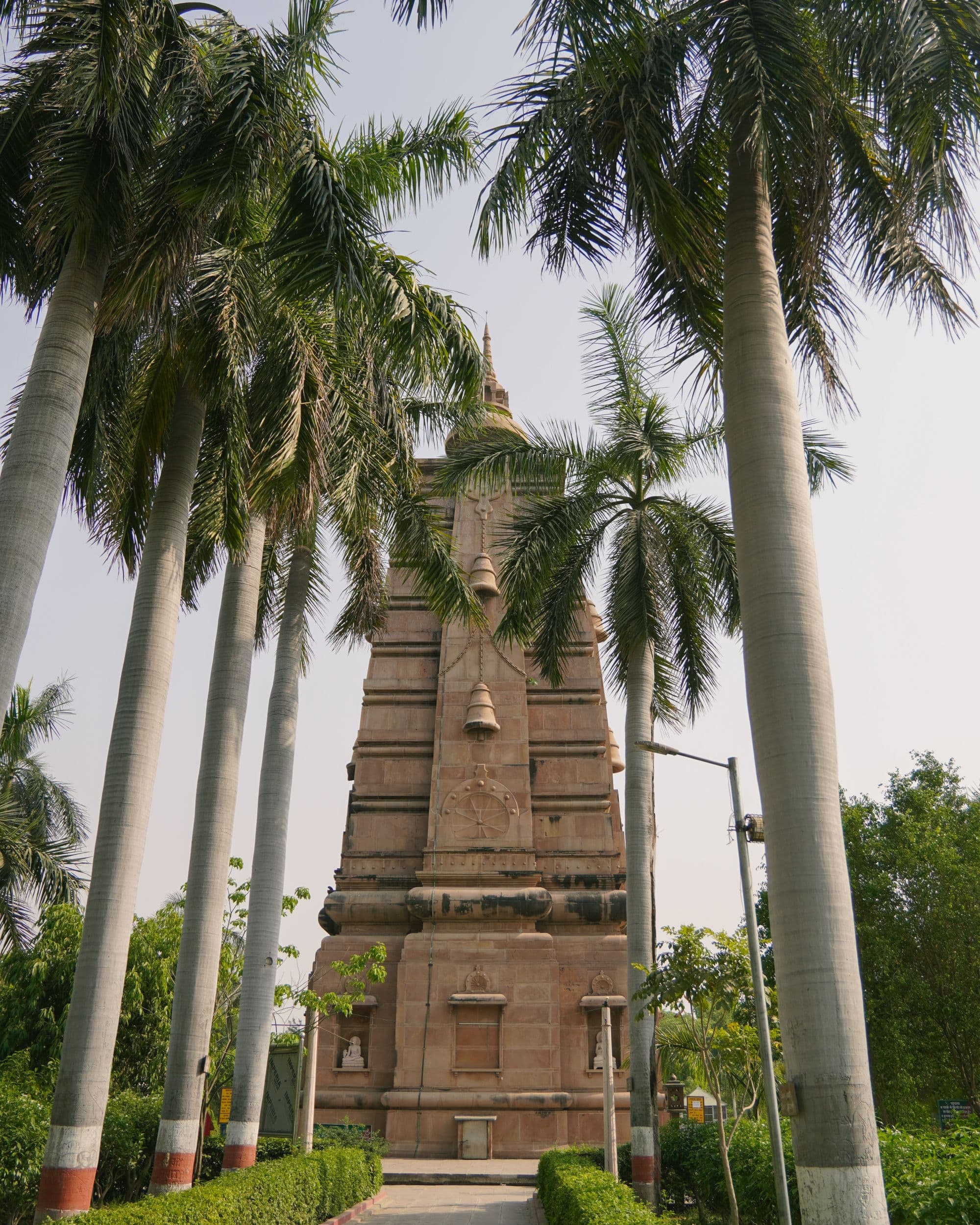
- What it isA temple of the 1930s with murals of the Buddha's life and a Bodhi tree in its garden
- Time30 min
- Temples of many nations
- What it isThai, Tibetan, Japanese, Chinese and Burmese monasteries near the park
- Time30 min
- Sarnath Museum
- What it isThe Lion Capital and some of the finest Buddhist sculpture in India
- Time1 hour
| Stop | What it is | Time |
|---|---|---|
| Chaukhandi Stupa | A brick stupa on the road in, marking where the Buddha met his five companions; a Mughal tower of 1588 on top commemorates Humayun's visit | 15 min |
| Archaeological park | The excavated deer park: the Dhamek Stupa, the Dharmarajika Stupa, the Ashokan pillar and monastery ruins | 1 hour |
| Mulagandha Kuti Vihara | A temple of the 1930s with murals of the Buddha's life and a Bodhi tree in its garden | 30 min |
| Temples of many nations | Thai, Tibetan, Japanese, Chinese and Burmese monasteries near the park | 30 min |
| Sarnath Museum | The Lion Capital and some of the finest Buddhist sculpture in India | 1 hour |
The Dhamek Stupa
The great solid cylinder at the heart of the park, about 43 metres high and 28 metres across, marks the traditional place of the first sermon. Its present form dates largely from the Gupta period, around the fifth and sixth centuries, built over older Mauryan foundations. Look at the lower part: bands of finely carved stone with flowing geometric and floral patterns, swastikas and birds. Pilgrims walk around it clockwise and press gold leaf onto its stones.
The Ashokan pillar and the Dharmarajika Stupa
Near the Dhamek, under a small shelter, stands the broken stump of the pillar Ashoka raised in the third century BCE, still carrying an edict warning monks and nuns against dividing the sangha. Beside it are the foundations of the Dharmarajika Stupa, one of Ashoka's, which was largely dismantled for its bricks in 1794. The ruins of monasteries spread around both.
Mulagandha Kuti Vihara
This temple was built by the Maha Bodhi Society, founded by the Sri Lankan Buddhist revivalist Anagarika Dharmapala, and opened in the early 1930s. Its walls are covered with murals of the life of the Buddha painted by the Japanese artist Kosetsu Nosu, who spent years on them. In the garden grows a Bodhi tree raised from a cutting of the sacred tree at Anuradhapura in Sri Lanka, which was itself grown from the tree at Bodh Gaya. In the evenings, monks chant here, and visitors are welcome to sit.
The Sarnath Museum and the Lion Capital
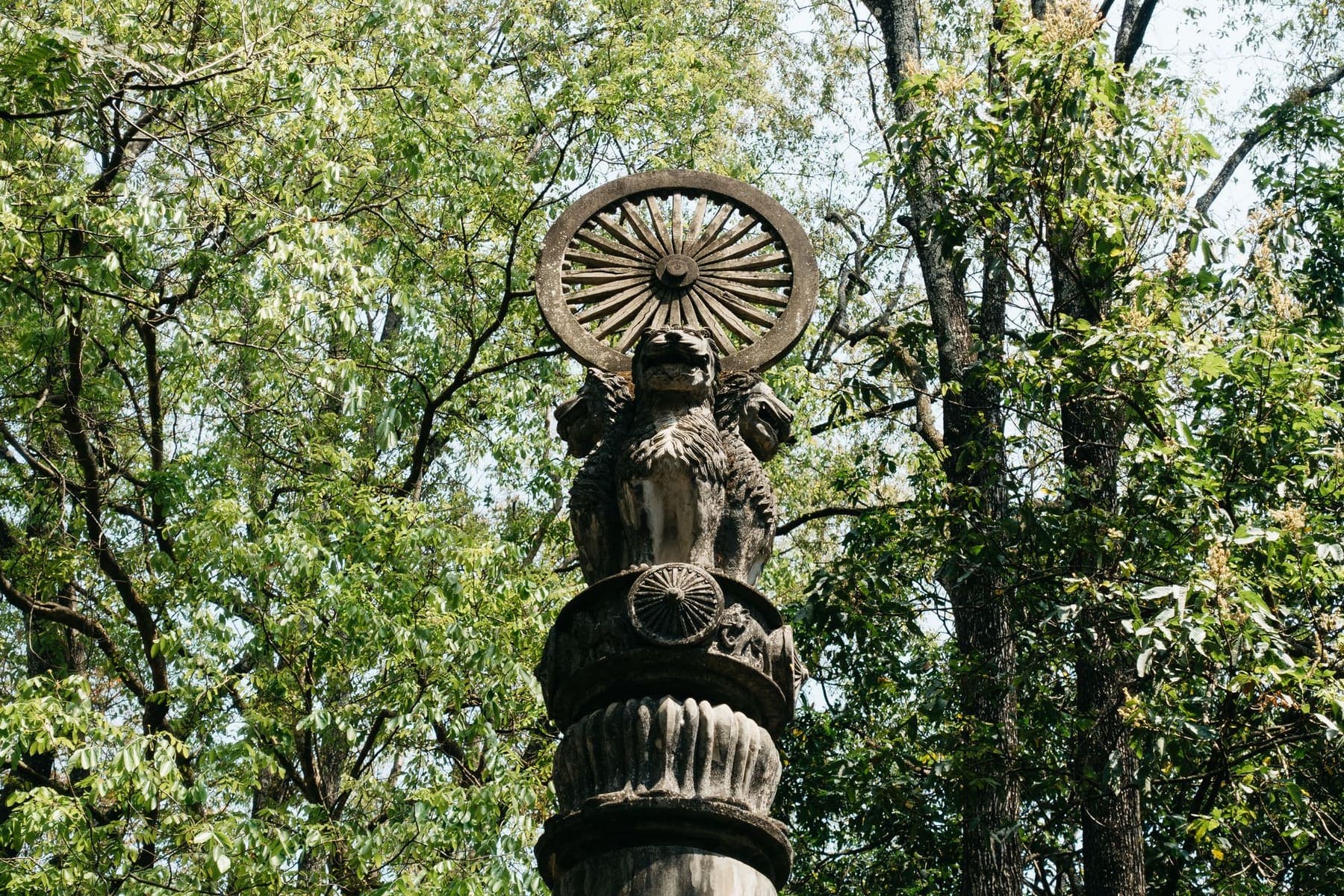
The Archaeological Survey of India's museum, one of the oldest site museums in the country, holds the treasure of Sarnath: the Lion Capital of Ashoka, four lions seated back to back on a drum carved with an elephant, a bull, a horse and a lion between wheels. Carved from a single block of polished sandstone, it is now the State Emblem of India, and the wheel on its drum is the one on the national flag. Don't miss the fifth-century seated Buddha in the teaching gesture, among the most serene sculptures in India.
Tickets and timings
- Archaeological park (Dhamek Stupa)
- Hours (approx.)Sunrise to sunset
- EntrySmall fee for Indian visitors; higher for foreign visitors
- Sarnath Museum
- Hours (approx.)About 9 AM to 5 PM, closed Fridays
- EntrySmall fee; children under 15 often free
- Mulagandha Kuti Vihara
- Hours (approx.)Morning and afternoon, closed at midday
- EntryFree
- Chaukhandi Stupa
- Hours (approx.)Sunrise to sunset
- EntrySmall fee
| Site | Hours (approx.) | Entry |
|---|---|---|
| Archaeological park (Dhamek Stupa) | Sunrise to sunset | Small fee for Indian visitors; higher for foreign visitors |
| Sarnath Museum | About 9 AM to 5 PM, closed Fridays | Small fee; children under 15 often free |
| Mulagandha Kuti Vihara | Morning and afternoon, closed at midday | Free |
| Chaukhandi Stupa | Sunrise to sunset | Small fee |
Fees are set by the Archaeological Survey of India and published figures vary; ASI sites increasingly sell tickets by QR code at the gate. With World Heritage status, fees may change; check at the counter.
How to get there from Varanasi
Sarnath is about 10 km north-east of the ghats, 30 to 45 minutes by road depending on traffic through the city. A private car or taxi is easiest and lets you stop at the Chaukhandi Stupa on the way; autorickshaws from the Cantonment or Godowlia also make the trip. There is a small railway station at Sarnath, but few trains are convenient.
When to visit
Sarnath is pleasant from October to March. The busiest day of the year is Buddha Purnima, the full moon of Vaishakh in April or May, when pilgrims from across Asia come for processions and prayers. From December to February, many monasteries hold teachings and pilgrim groups from Sri Lanka, Thailand, Myanmar and Tibet fill the park with robes of every colour.
Etiquette
- Walk clockwise around the stupas and shrines, keeping them on your right.
- Dress modestly and remove your shoes before entering temples.
- Keep your voice down; many visitors here are on pilgrimage, and some are meditating.
- Ask before photographing monks or anyone at prayer.
- Never climb on the stupas or ruins, or point your feet at an image of the Buddha.
For the story of how the Buddha reached Sarnath, read our piece on Bodh Gaya and the Bodhi tree. Sarnath is part of our Kashi in Four Days journey, and fits easily into the third day of our guide to how many days to spend in Varanasi.
Questions people ask
- How far is Sarnath from Varanasi?
- About 10 km north-east of the ghats, 30 to 45 minutes by car depending on traffic.
- Is Sarnath a UNESCO World Heritage Site?
- Yes. The Ancient Buddhist Site of Sarnath was inscribed on 25 July 2026, India's 45th World Heritage Site, after 28 years on the tentative list.
- Is the Sarnath Museum open on Friday?
- No. The museum is closed on Fridays and open from about 9 AM to 5 PM on other days. The archaeological park stays open.
- How much time do you need in Sarnath?
- Half a day: about three to four hours for the park, the Mulagandha Kuti Vihara, the Chaukhandi Stupa and the museum.
- Where is the original Ashoka Lion Capital?
- In the Sarnath Museum. It is the State Emblem of India; the replica in the park shows it with the wheel that crowned it originally.

About this guide
Written for the WanderMate Journal by our team in Varanasi, where we plan and run journeys along the Ganga. We check facts against official and published sources, listed below, and revise guides when timings, prices or dates change. Last updated 14 October 2026.
Spotted something out of date? Tell us.
Sources