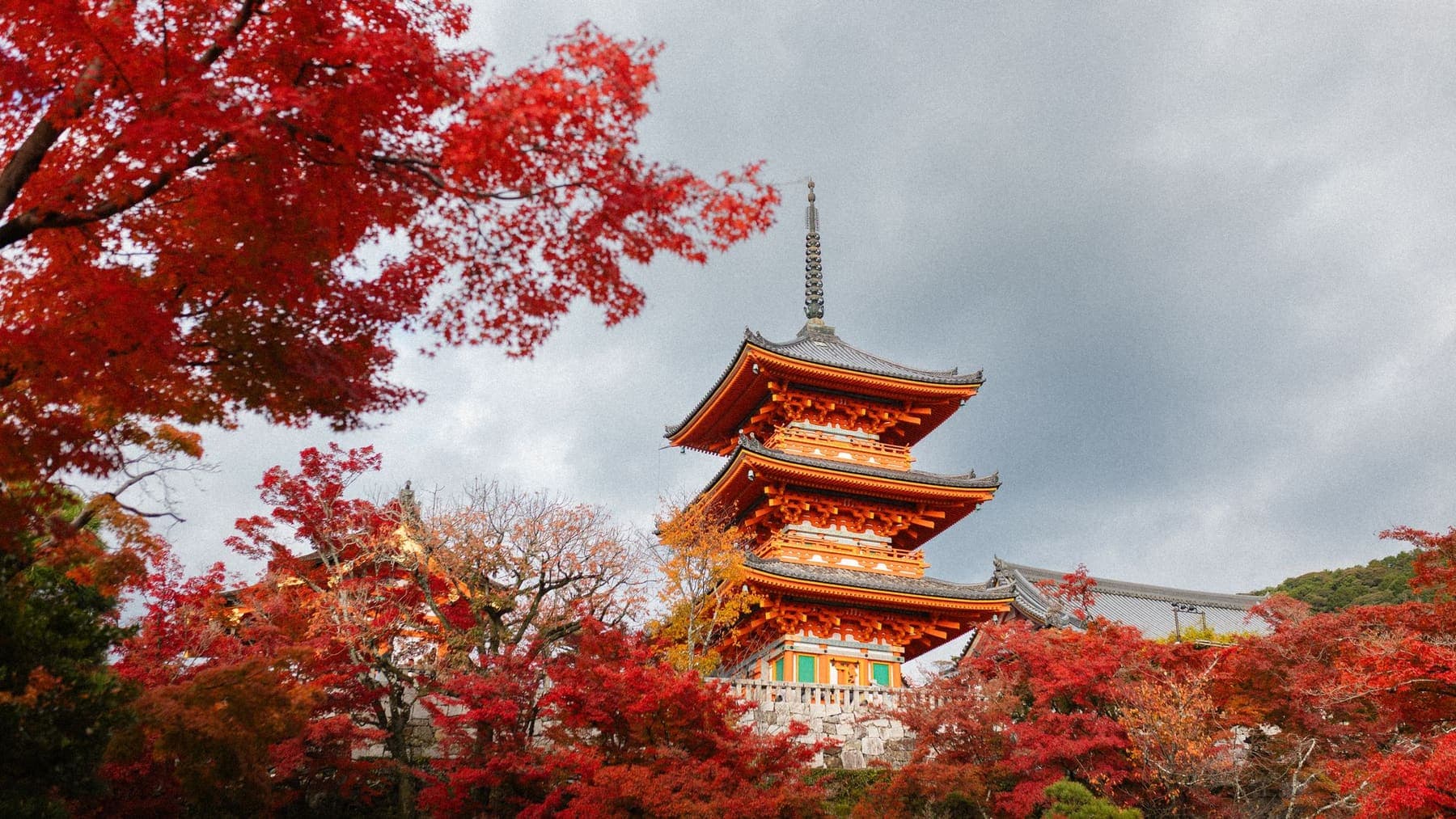
For a few weeks each year, Kyoto's temple gardens turn crimson and gold, and the city fills with people who have come to see them. When to go in 2026, the gardens worth the journey, the evening illuminations, and how to find a quiet corner of a crowded season.
The short answer
Kyoto's autumn leaves usually peak from late November to early December. The first 2026 forecasts expect a late season, with ginkgo at its best around 27 November and red maples around 11 December in the city, and earlier in the hills at Ohara and Kurama. Tofuku-ji, Eikan-do, Kiyomizu-dera and Arashiyama are the classic places; arrive at opening time on a weekday.
Key points
- City peak: late Nov to early Dec
- 2026 is forecast late: maples around 11 Dec
- Hills turn first: Ohara, Kurama, Takao
- Go at opening, on weekdays, by train
The Japanese have a word for going out to look at the autumn leaves: momijigari, literally maple hunting. In Kyoto it has been a pastime for a thousand years; courtiers of the Heian period wrote poems about the maples of Arashiyama, and the same hillsides still turn red each November. With its seventeen World Heritage sites and hundreds of temple gardens planted for exactly this season, the old capital is the most celebrated place in Japan to see koyo, the turning of the leaves.
It is also, for the same reason, one of the most crowded. The secret to a good autumn in Kyoto is timing: the right week, the right hour and the right garden. This guide sets out the 2026 forecast, the places worth your time and how to see them in something like peace.
When do Kyoto's leaves peak in 2026?
Colour follows the cold. The leaves begin to turn once morning temperatures fall below about 8°C, so the hills around the city change first and the sheltered gardens of the centre last. In an average year, the city's maples are at their best from about 20 November to 5 December.
2026 is expected to be late. The first forecasts, published in September, put the yellow ginkgo at its best in Kyoto around 27 November and the red maples around 11 December, about six days later than average after a hot summer. Another forecaster expects Arashiyama to peak around 24 November. Forecasts are updated through October and November, and actual colour varies garden by garden, so check again before you travel and give yourself a few days of leeway.
- Takao, Kurama and Kibune (north hills)
- Typical bestEarly to mid-November
- NotesCooler mountain valleys turn first
- Ohara (Sanzen-in, Hosen-in)
- Typical bestMid to late November
- NotesA rural valley an hour north of the centre
- Arashiyama and Sagano
- Typical bestMid to late November
- NotesHillsides above the Hozu river; very busy
- Higashiyama (Kiyomizu-dera, Eikan-do, Nanzen-ji)
- Typical bestLate November to early December
- NotesThe eastern hills of the city
- Tofuku-ji and the city centre
- Typical bestLate November to early December
- NotesOften the last major garden to peak
| Area | Typical best | Notes |
|---|---|---|
| Takao, Kurama and Kibune (north hills) | Early to mid-November | Cooler mountain valleys turn first |
| Ohara (Sanzen-in, Hosen-in) | Mid to late November | A rural valley an hour north of the centre |
| Arashiyama and Sagano | Mid to late November | Hillsides above the Hozu river; very busy |
| Higashiyama (Kiyomizu-dera, Eikan-do, Nanzen-ji) | Late November to early December | The eastern hills of the city |
| Tofuku-ji and the city centre | Late November to early December | Often the last major garden to peak |
Typical windows; in a warm year like 2026 is forecast to be, each may come a week or so later.
The essential gardens
Tofuku-ji
If you see one place, see this. The great Zen temple in south-east Kyoto sits above a ravine planted with some two thousand maples, crossed by the wooden Tsutenkyo bridge. From the bridge you look down on a sea of red. It is also the most crowded place in Kyoto in late November: for 2026 the temple has listed a separate autumn ticket of about ¥1,000 for the Tsutenkyo area from 14 November to 6 December, and in recent years it has asked visitors not to stop for photographs on the bridges at peak times. Come at opening, or on a weekday in early December.
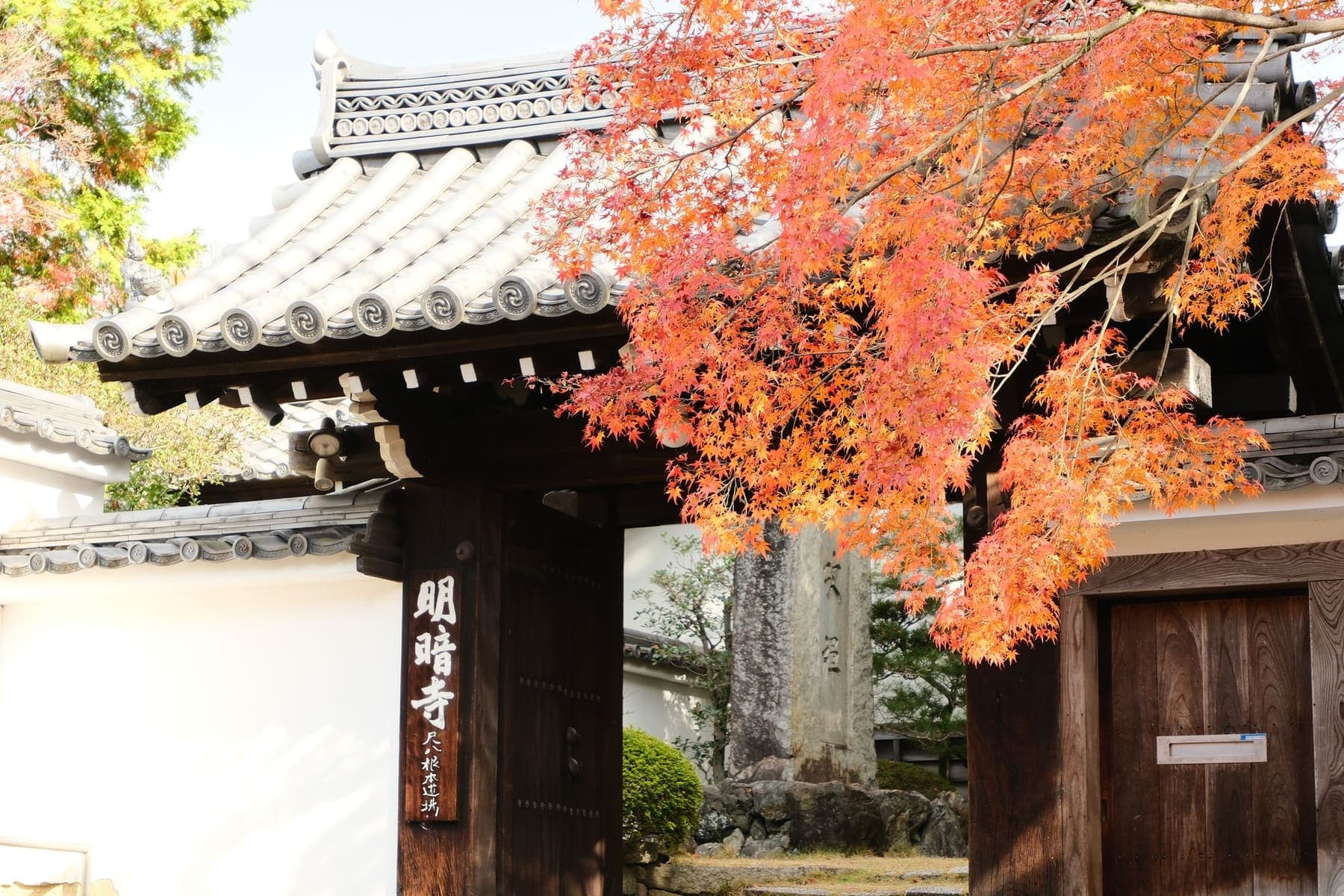
Eikan-do (Zenrin-ji)
Known for centuries as Momiji no Eikan-do, Eikan-do of the maples, this temple climbs a hillside in Higashiyama with a pagoda rising out of the trees and a pond full of reflections. It is famous for its evening illumination, in 2026 expected from about 20 November to 6 December with a separate ticket of around ¥1,000. Combine it with Nanzen-ji next door, where the brick aqueduct of Suirokaku runs through the maples.
Kiyomizu-dera
The great wooden stage of Kiyomizu-dera, built out over the hillside on tall pillars, looks down on a valley of maples, with the city beyond. The temple holds a special night viewing in late November, when the trees are lit and a blue beam of light sweeps the sky. By day, go at 6 AM, when it opens; by mid-morning the lanes of Sannenzaka below are packed.
Arashiyama
In the west of the city, the wooded hills above the Togetsukyo bridge turn every shade of red and gold. Tenryu-ji, a World Heritage Zen temple, has a fourteenth-century garden designed around the view of the hills, and the smaller temples of Sagano beyond it, Jojakko-ji, Nison-in and Gio-ji with its moss garden, are among the most beautiful in Kyoto in autumn. Walk north from the bamboo grove early, before the day-trippers arrive.
“Go to the famous gardens at opening time, and spend the rest of the day in the ones nobody has heard of.”
Quieter places to see the colour
- Ohara: Sanzen-in and Hosen-in, in a farming valley about an hour north by bus; at Hosen-in, you sit on tatami with matcha and look at the garden framed like a painting.
- Shinnyo-do: a temple in the north of Higashiyama with a pagoda and maples, and a fraction of Eikan-do's crowds.
- Kitano Tenmangu's Momiji-en: a garden of about 350 maples along the Kamiya river, with a vermilion bridge, lit in the evenings.
- Kibune and Kurama: take the Eizan Railway north through the momiji tunnel, lit at night, then walk the mountain path between the two villages.
- Shoren-in: a temple of the imperial family in Higashiyama, with a quiet evening illumination and room to sit.
Evening illuminations
From mid-November, several temples open at night with the maples lit from below, a tradition known as light-up. The effect is theatrical and often beautiful, and evening tickets are sold separately from daytime entry. Expect queues at the best known.
- Eikan-do
- Expected datesAbout 20 November to 6 December
- Ticket (approx.)About ¥1,000
- Kiyomizu-dera
- Expected datesLate November
- Ticket (approx.)Check the temple's site
- Kodai-ji
- Expected datesMid-November to early December
- Ticket (approx.)Check the temple's site
- Shoren-in
- Expected datesLate October to early December
- Ticket (approx.)Check the temple's site
- Kitano Tenmangu Momiji-en
- Expected datesMid-November to early December
- Ticket (approx.)Includes tea and a sweet
| Temple | Expected dates | Ticket (approx.) |
|---|---|---|
| Eikan-do | About 20 November to 6 December | About ¥1,000 |
| Kiyomizu-dera | Late November | Check the temple's site |
| Kodai-ji | Mid-November to early December | Check the temple's site |
| Shoren-in | Late October to early December | Check the temple's site |
| Kitano Tenmangu Momiji-en | Mid-November to early December | Includes tea and a sweet |
Dates and fees from 2026 planning guides and previous years; temples confirm them in October. Last entry is usually 30 minutes before closing.
How to beat the crowds
- 1Go at opening. Most temples open between 8 and 9 AM; Kiyomizu-dera opens at 6 AM. The first hour is the calmest of the day.
- 2Avoid weekends and holidays. Labour Thanksgiving Day, 23 November, is a public holiday and one of the busiest days of the year.
- 3Travel by train, not bus. City buses to the famous temples are overloaded in autumn. Use the subway, the Keihan, Hankyu and JR lines, and walk the last stretch.
- 4Stay central and stay several nights. It lets you go out early and come back to rest at midday.
- 5Look up the colour, not just the forecast. Live reports on Japanese foliage sites update daily in November.
Etiquette in the gardens
- Keep to the paths and do not touch or shake the branches for a photograph.
- No tripods or selfie sticks in most temple gardens, and no drones anywhere in the city without a permit.
- Respect private lanes in Gion, where photography on private roads is now banned and can bring a fine.
- Take off your shoes where asked, and wear socks; many halls are entered on tatami.
- Speak quietly. These are working temples, and some visitors come to pray.
Planning a journey
Give Kyoto at least four nights in autumn: two for the eastern hills and Tofuku-ji, one for Arashiyama, and one for the north, Ohara or Kurama. A night in a temple lodging on Mount Koya, south of Osaka, makes a beautiful ending. For the Shinto side of the city, read our story on Fushimi Inari and its thousand gates. We plan private journeys to Kyoto on request, built around the temples, the gardens and the city's living crafts.
Questions people ask
- When is the best time to see autumn leaves in Kyoto in 2026?
- Late November to early December. The first 2026 forecasts expect ginkgo to peak around 27 November and red maples around 11 December in the city, later than average.
- Where are the best autumn leaves in Kyoto?
- Tofuku-ji, Eikan-do, Kiyomizu-dera and Arashiyama are the classics. For fewer people, try Ohara, Shinnyo-do, Kitano Tenmangu's Momiji-en and the Kibune and Kurama valley.
- How can I avoid the crowds in Kyoto in autumn?
- Arrive at opening time, visit on weekdays, avoid 23 November, use trains rather than buses, and visit sub-temples within the big complexes.
- Do Kyoto temples have night illuminations in autumn?
- Yes. Eikan-do, Kiyomizu-dera, Kodai-ji, Shoren-in and others open at night from mid-November to early December, with separate evening tickets.
- Is there a fee to see the autumn leaves at Tofuku-ji?
- Yes. For 2026 the temple has listed an autumn ticket of about ¥1,000 for the Tsutenkyo bridge area from 14 November to 6 December.

About this guide
Written for the WanderMate Journal by our team in Varanasi, where we plan and run journeys along the Ganga. We check facts against official and published sources, listed below, and revise guides when timings, prices or dates change. Last updated 14 October 2026.
Spotted something out of date? Tell us.
Sources